WEEKLY POINTS
This week’s guide to government and politics in under 10 minutes
Our Next Gen series with Reuters is heading to Boston for The Health Reset, a live conversation about wellness in America. Details and registration info at the bottom of this email.

I SAME-NAME SENATE CANDIDATES LEAD TO PRE-EMPTIVE DOJ LAWSUIT IN ALASKA
The Department of Justice (DOJ) filed a lawsuit to prevent Alaska state officials from certifying election results if incumbent Republican Senator Dan Sullivan loses in November. The lawsuit argues that the presence of an independent candidate also named Dan Sullivan is a deliberate attempt to mislead voters. The DOJ argues there’s a possibility that, under the state’s ranked-choice voting system, voters might not rank the incumbent at all or will accidentally rank the challenger over him. The lawsuit asks to delay certification until an investigation determines ”whether votes cast for Daniel J. Sullivan were meant to be cast for Senator Sullivan.” Alaska’s state supreme court allowed Daniel J. Sullivan to remain on the ballot in a June ruling. The challenger is a registered Republican, but is listed on the ballot without a party affiliation. The ballot lists Senator Sullivan as “Registered Republican” and “incumbent.” In the state’s primary, the incumbent Sullivan won 68,726 votes to Daniel J. Sullivan’s 4,107.
>> See a demonstration of how ranked-choice voting works in Alaska (and Maine) here.
I JUDGE RESTRICTS DHS FIELD OPERATIONS LOOKING FOR NONCITIZEN VOTERS
A federal judge blocked the Department of Homeland Security (DHS) from carrying out most field operations in nine states focused on finding voter fraud as part of its broader effort to identify noncitizen voters. The ruling covers stops and field interviews. The DHS had assigned hundreds of agents to canvas the country to search for instances of voter fraud under the Trump administration's “Unlawful Voter Initiative.” In the ruling, the Judge wrote that stops appeared likely to suppress voter engagement and registration by a coalition of local government and nonprofit groups, and that the government-generated “target lists” already contained errors and included naturalized citizens. The DHS defended its methods, saying federal officers used multiple data sources, in addition to public voter data, to verify registrants’ identities. The ruling bars agents from carrying out interviews that “involve or are likely to involve persons” whom agents “know, suspect, or should reasonably know or suspect are U.S. citizens.”
>> Find out which states are adding additional proof-of-citizenship requirements for voter registration here.
I DOJ SAYS IT COULD BLOCK ELECTION CERTIFICATION IN “DOOMSDAY SCENARIO”
Attorney General Todd Blanche said the DOJ could intervene in states’ midterm election certification process under what he called “hypothetically, you know, some doomsday scenario, for example.” He added that the DOJ does not plan to “improperly interfere with elections or the state confirmation process or certification process.” Previously, Blanche described plans to send 1,000 DOJ election monitors to polling places in every state on Election Day, saying the department’s presence would serve to ensure federal law is properly enforced. The federal government has deployed election monitors in every election since at least the 1960s.
>> Dig deeper into how states certify elections here.
I U.S. ISSUES KENYA TRAVEL WARNING OVER EBOLA SPREAD
The U.S. raised its travel advisory to Kenya from Level 2 to Level 3, the highest warning level, and asked Americans to reconsider any travel to the African nation. The advisory level increased due to the spread of Ebola from neighboring countries. According to the U.S. advisory, “Medical services in Kenya are limited. They are often unavailable in rural areas. Medical facilities in Kenya often lack sufficient medicine and equipment.” The government also issued new screening measures for U.S.-bound air travelers, requiring them to attest they had not been in the Democratic Republic of Congo in the previous 21 days.
>> Hear an Ebola expert explain the odds that an Ebola outbreak could spread to the U.S. here.
I MORE THAN 1.5 MILLION POUNDS OF MEAT & POULTRY PRODUCTS RECALLED NATIONWIDE
The U.S. Food Safety and Inspection Service (FSIS) has issued a recall of more than 1.5 million pounds of ready-to-eat meat products after finding they were stored at an improper temperature. The recall is aimed at products from Kayem Foods, Inc. Recalled products have establishment numbers “EST. M/P 7839,” “EST. P 20935A” and “EST. M 9520” in the USDA inspection seal on their packaging. Recalled products include hot dogs, bacon, corned beef, deli-style turkey breast, and chicken sausage.
>> Understand how U.S. food recalls work here.
The Health Reset, Live in Boston
What goes into our food and everyday products and who decides what is safe? ASP and Reuters are bringing that conversation to Boston on November 16th for The Health Reset, a live conversation about the people and policies shaping our health choices, from food additives to ultra-processed foods, vaccines, and medications.
ASP’s Chris Evans and Mark Kassen and Reuters Global Health and Pharma Editor Michele Gershberg will be joined by experts, culture and thought leaders, and policymakers to explore modern health in America.
Tickets are free, but space is limited. Get the details and request tickets here

Silver Has Beaten Gold Before. It's Doing It Again.

From 1974 to 1987, silver more than doubled gold's returns. After 2008, it beat gold five-fold in three years. Since March 2020, silver is up 402% against gold's 186%. Our research team's free playbook explains why, and how the team would position.
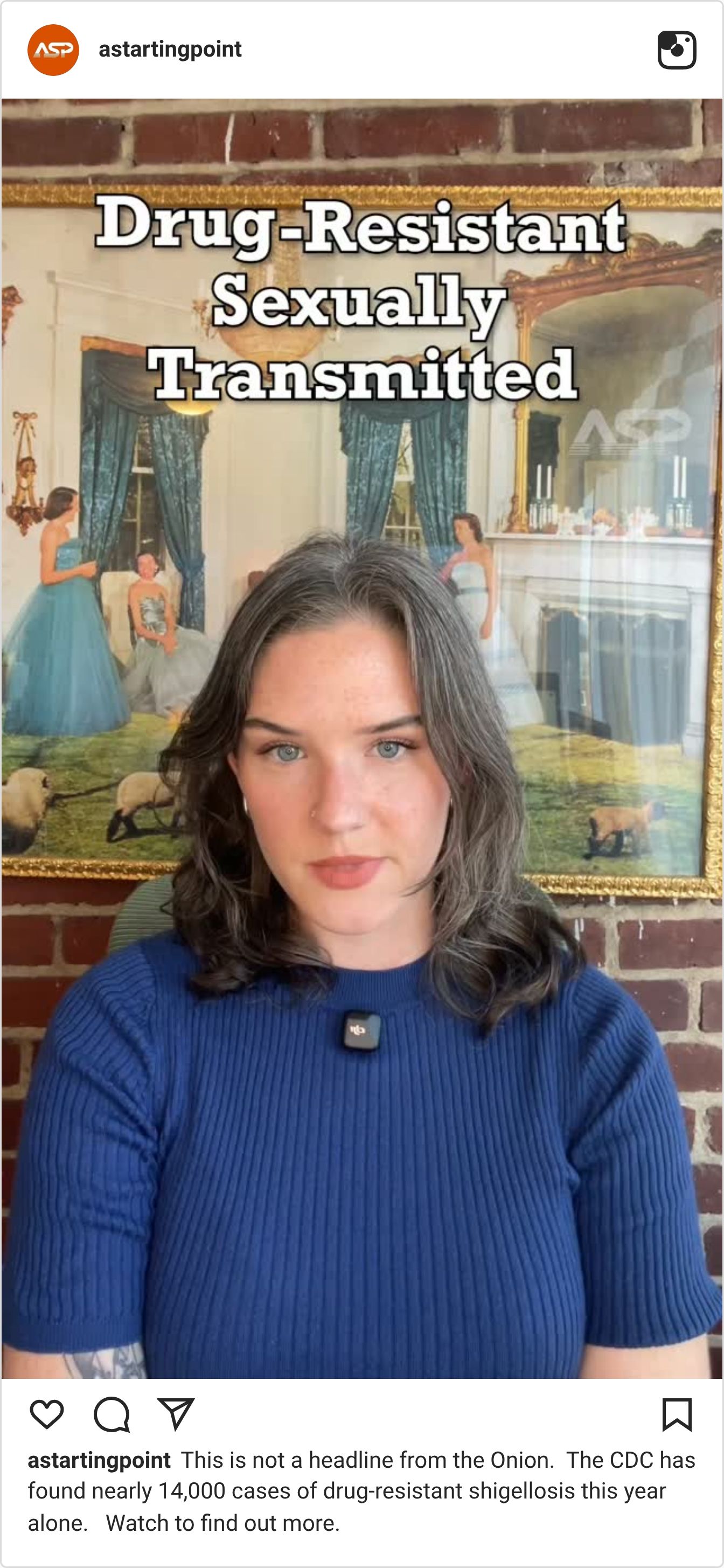
🦠🧻 DRUG-RESISTANT SEXUALLY TRANSMITTED DIARRHEA 🧻🦠
It’s not an Onion headline — cases of drug-resistant sexually transmitted diarrhea are increasing. 🚽
TALKING POINTS
Stay ahead of the stories driving national conversations
I EXPLAINER
IT’S SAFE, TRUST US
The government is changing how it views ingredients “Generally Recognized as Safe”
I EXPLORES
STATE OF PLAY: AI & CAMPAIGN ADS
How are state governments approaching the surge in AI-generated campaign ads?
I EXPLAINER
LAWSUIT SEEKS TO BLOCK TELEHEALTH ABORTIONS
Find out which states outlaw telehealth abortion prescriptions
Help Us Grow
We started this newsletter to demystify information and make engaging with elected officials super accessible. But we can’t do it alone. If you believe in our mission, help us spread the word. When you invite someone to join, you're fueling our growth and helping us keep creating the kind of content you love. If you know anyone who would enjoy what we’re building, send them our way.
