WEEKLY POINTS
This week’s guide to government and politics in under 10 minutes
Happy July. In case you were on vacation last week, it’s time to catch up on some major Supreme Court decisions.

I COURT REJECTS TRUMP’S BIRTHRIGHT CITIZENSHIP ORDER
The Supreme Court ruled against President Donald Trump’s birthright citizenship executive order, which attempted to deny citizenship to children born to parents here illegally or temporarily. The Court determined that the order violated the Constitution’s 14th Amendment. The ruling was a 5-4 decision with Chief Justice John Roberts writing for the majority. Justices Elena Kagan, Sonia Sotomayor, Amy Coney Barrett, and Ketanji Brown Jackson joined that opinion, with Justice Brett Kavanaugh dissenting, writing that the order was constitutional but that he believed it violated federal law. Justices Clarence Thomas, Samuel Alito, and Neil Gorsuch would have allowed the order to stand.
>> ASP breaks down the decision here.
I DRUG USE DOES NOT PREVENT GUN OWNERSHIP
Casual drug use does not make it illegal to own a gun after the Court’s decision in United States v. Hemani. The case looked at a federal law that prohibited people from possessing a gun if they used illegal drugs. The Court found that merely using illegal drugs doesn’t prove that a person is a danger to the public and thus is not a reason by itself why it should be illegal for that person to have a gun.
>> Find out the facts of the case and how the decision shapes the law here.
I LAW BANNING TRANSGENDER PARTICIPATION IN WOMEN’S SPORTS UPHELD
State laws in Idaho and West Virginia banning transgender athletes from participating in women’s sports were affirmed by the Court. All nine justices ruled that the state laws do not violate federal civil rights laws, but split 6-3 over whether the laws violated the Equal Protection Clause of the Constitution. While the decision doesn't impose a nationwide ban on transgender athletes participating in women's sports, it does allow states to set their own laws, like those in Idaho and West Virginia.
>> Learn about the details of the decision here.
I PARTIES ALLOWED MORE COORDINATION WITH CANDIDATES
Political parties can spend unlimited amounts of money in coordination with specific candidates after the Court’s 6-3 ruling in National Republican Senatorial Committee (NRSC) v. Federal Election Commission (FEC). The resulting decision is likely to decrease the influence of Super PACs, which are not allowed to coordinate with individual candidates, while also increasing the power of political parties to influence which candidates win primary elections.
I COURT LOOSENS RESTRAINT ON EXECUTIVE POWER
The Supreme Court gave the president the power to fire members of about two dozen multi-member agencies that Congress had intended to be independent. The 6-3 decision struck down a federal law barring the president from firing members of the Federal Trade Commission without cause. The Court found that such laws violate the Constitution's separation of powers between the three branches of government, overturning a 91-year-old precedent. However, in a separate case, the Court also blocked the president from firing members of the Federal Reserve, writing that the “quasi-private” nature of the Fed made it a unique case regarding executive power.
>> Find out more about what the Federal Reserve does to make it unique here.
💎🛥️AW, YOU SHOULDN’T HAVE🛥️💎
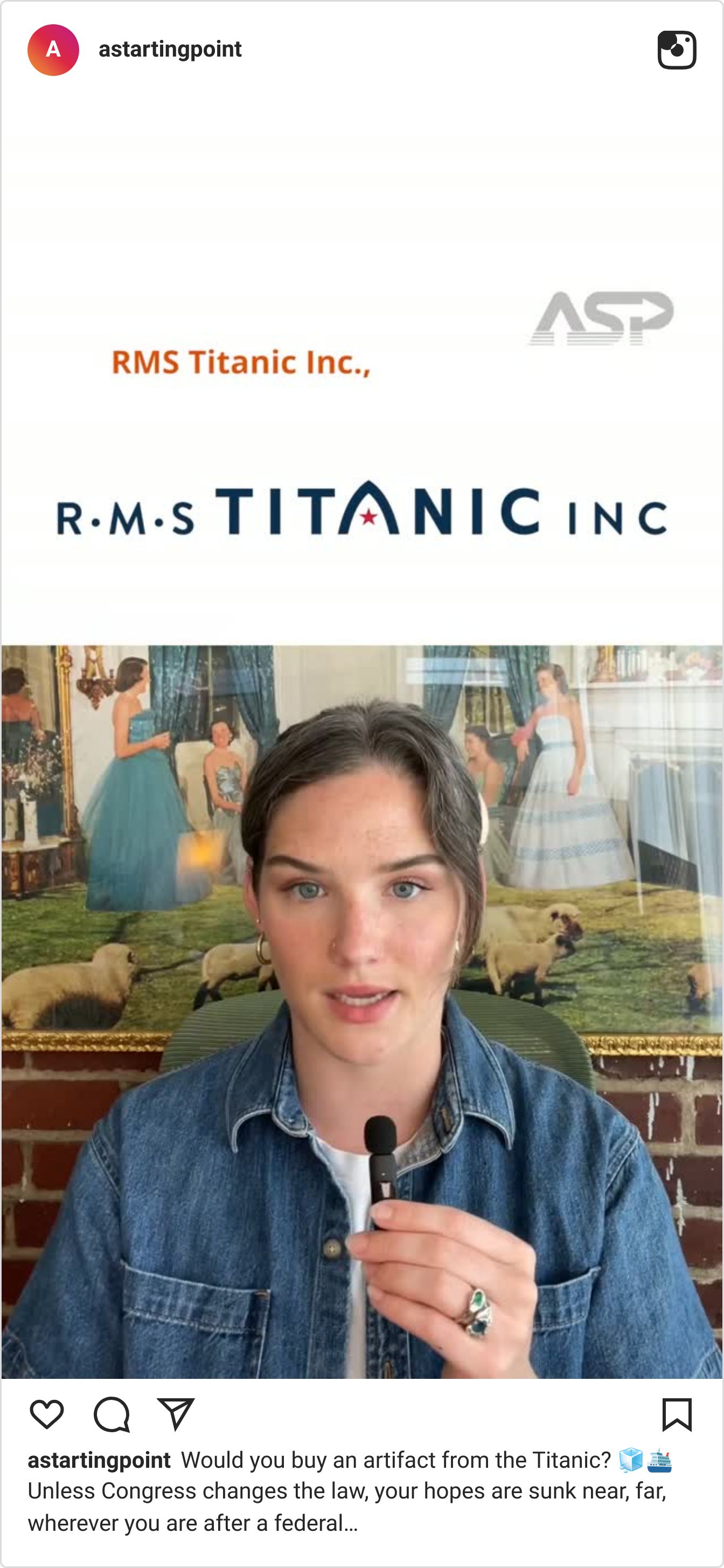
Watch to find out why the National Oceanic and Atmospheric Administration blocked a company from auctioning off artifacts from the Titanic wreck site.
TALKING POINTS
Stay ahead of the stories driving national conversations
Help Us Grow
We started this newsletter to demystify information and make engaging with elected officials super accessible. But we can’t do it alone. If you believe in our mission, help us spread the word. When you invite someone to join, you're fueling our growth and helping us keep creating the kind of content you love. If you know anyone who would enjoy what we’re building, send them our way.
